
Creating a professional landing page or a multi-page web resource today does not require a dedicated design team or backend engineers. Online website builders (SaaS) simplify the path from architecture to deployment—from simple lead-gen funnels to scalable e-commerce stores. This review analyzes the top platforms for rapid deployment with minimal technical overhead.
What is a Website Builder and How Does it Work?
A simple website builder is a cloud-based service (SaaS) operating on the WYSIWYG (What You See Is What You Get) principle. No knowledge of PHP, HTML, or JavaScript is required. The entire process is centered around visual editing: you simply use drag-and-drop to move elements, configure their styles, and see the results instantly.
For those who need a single-page site (landing page), a builder is the optimal choice. It allows you to focus on conversion and marketing logic rather than technical server maintenance or backend development.
Key advantages over CMS (WordPress, etc.):
- All-in-One: Hosting, SSL certificate, and basic security are pre-integrated.
- Speed: Deployment takes hours, not days.
- Security: There is no need to manually update plugins or monitor code vulnerabilities.
How to Create a Site from Scratch: 8 Steps to Launching a Landing Page
To build a site efficiently via a builder, follow this algorithm:
- Define the Goal: Lead generation landing page, business card site, or e-commerce store.
- Select a Platform: Refer to the top website builders list provided in this review.
- Select a Template: Choose a layout that closely matches your specific niche.
- Customization: Configure colors, typography, and block structure.
- Content: Add text, images, and video payload.
- SEO Configuration: Set up meta tags and headers (H1–H3) for proper indexing.
- Domain Mapping: Connect the builder to a domain (either provided by the service or purchased separately from reputable domain registrars).
- Deployment: Click the “Publish” button. The site is now ready for traffic acquisition.
Quick Selection Guide
Website builders vary significantly in their features, advantages, and limitations. Certain platforms are optimized for e-commerce, while others excel at personal portfolios, single-page sites, or high-conversion landing pages. This review identifies the optimal builder based on specific use cases.
Use this section to match a platform with your technical and business requirements.
| The modern SendPulse webpage builder extends the capabilities of the service by simply creating a website. Create a page and promote it through chatbots in messengers (Telegram, Facebook, Vkontakte, WhatsApp), email, Push and SMS - all on one platform! Connect payment systems, analytics, Push service in one click. With the SendPulse mini-branding editor you can create a working single-page website for free. Newbie? Sign up and get a $10 gift! |
| The free plan includes all the basic features with a limited limit: 3 funnels, 1 automation rule, 1 custom domain, and up to 2,000 contacts. Ideal for testing the platform. |
| Website builder from Email marketing service GetResponse - create a free account with all marketing tools (no credit card required)! |
| Your website, your rules: Use a powerful visual editor with access to SEO settings and analytics to transform a simple landing page into an effective sales tool. |




How website builders work in practice
If you have thought about creating your own website, you have probably heard of CMSs such as WordPress, Joomla, 1C-Bitrix, OpenCart, Drupal, which allow you to develop websites not online (directly on the platform website), but by downloading the distribution package in advance and making website development a separate, manual process. You will also need to buy a domain name and hosting separately.
SaaS (Site as a Service) designers, originally designed for the average Internet user, allow you to develop websites online – without having to download anything. Differences from CMS:
- The construction of the site takes place directly on the Internet – on the site of the site builder itself.
- You don’t need to know how to program, design web pages in graphic editors like Adobe Photoshop or make HTML code. For this website builders have special visual editors, or as they are also called – Drag and Drop editors, which allow you to visually control the construction of the site.
In practice, you register on the website builder website. You choose the website design template you like, according to the category of your website. Then the template you choose is opened in the visual Drag and Drop editor, which is usually very simple and intuitive. There you edit existing sections of the page or create new ones. You can add, move content blocks, add photos, videos, change various design parameters. And, importantly, you can do it all yourself, without any technical training. The advantages of website builders do not end there. Once you have built a visual design of your site, you click “Done” – and your site is working. You do not need to separately buy hosting for it, manually register DNS and make other settings that are required when using a CMS.
This is not to say that using a CMS is a bad idea, it’s just that using one will require you to have professional web development skills and technical knowledge. But you will have more freedom, more opportunities to customise the site.
What to look out for when choosing a website builder
- How big is the choice of web templates (layouts). The more the better in the niche you want. To avoid wasting time browsing through all the templates in a row, select the right category. To do this, specify the appropriate category in the search filter, e.g. Blog/Magazine, for an online shop the category is usually called eCommerce, etc.
- The quality of templates for the website. The quality of available templates, is one of the main factors. First and foremost, check the adaptive design, that is, how the template will look on a mobile device.
- Drag & Drop editor available. The Drag & Drop editor allows you to move and adjust the blocks and structure of your website with just the mouse. This is very convenient and greatly simplifies the website design process.
- Optimisation for SEO (SEO-friendly). Before choosing a web constructor, research how well sites developed on this platform are indexed by search engines. The website builder should not limit you in the SEO-optimisation possibilities, as this is crucial for the promotion of your online shop.
- Qualification and responsiveness of the technical support. We recommend that you contact the technical support team during the test period and evaluate their work yourself. Pay attention both to the usefulness of the answer and to the speed. Acceptable response time – up to 24 hours. The best website builders usually respond faster – up to 10 hours.
- Available number of pages of the site. Some constructors, usually on free plans only, impose restrictions on the maximum number of pages the site can have.
- The amount of disk space. The more space the site has, the better. This will allow you to upload more photos, videos and other content to the site. Almost all website builders can at any time to buy additional disk space, but you’d better prudently ask how much of it is available initially. There are also site designers who have unlimited disk space in the basic version.
- The age and reputation of the constructor. Only choose proven website builders that have been around for at least a few years. When developing your website with the help of a website constructor, you should understand that your website will be alive as long as the constructor itself is alive. Website constructors appear with the hope to achieve success and recognition, exist for a year or two, then go bankrupt and close down.
- Integration with social media. It’s not just sharable buttons, but the ability to send events to the analytics systems of the social networks you want.
- Implementing the connection of an electronic payment acceptance system.
- Connection of different analytics systems. A minimum of Facebook and Google Analytics, with the ability to easily set up conversions.
- A/B testing is a simple way to measure effectiveness: it helps you compare two versions of something and determine the best one for your project. You can find out which version of your site is more user-friendly, which web address is easier for visitors to remember and find faster on the web, which headline is more clickable, and more. You can test anything you like: new features, calls to action, additional buttons and blocks, page layout, designs, rates and discounts, domain name options, and so on. It is important to translate successful results into permanent practice.
Below is a list of unique features you may need:
- It is possible to move the website to another web hosting service. This option is usually paid and expensive.
- The ability to upload your own web template.
- The possibility of self-editing the code.
- Availability of its own web analytics system.
Choose a paid or free website builder
Some constructors, along with paid features, also offer a free plan with no time limit on usage. But all free website builders have a number of limitations:
- Availability of advertising. For the right to have a free site, constructors place advertisements on your site. This can be a banner, a block of contextual advertising with links, a small logo or a text link in the footer. If you want to remove ads, pay for a basic plan and they disappear, or just accept their presence on your site. In other words, either you pay for the use of website builder or it places ads on your site. Free website builders without any advertising does not exist! Do not waste your precious time searching for free website builders without advertising – it is better to spend it on checking the functionality.
- Limit the number of pages. Many free website builders have a limit on the maximum number of pages (often up to 10 pages).
- Limiting the number of items for sale. Yes, this limitation is important for an online shop, but for creating a commercial pade landing page it’s not a hindrance. Usually a one-page website sells one unit of a product.
- Using your own domain name. Free website builders provide users with a domain name as a third-level domain. For example: yoursite.nethouse.ru – where “yoursite” is any word you choose from those available. To use your domain name, you will have to buy a paid plan and then either buy a domain or link your own domain, if it is purchased from another domain registrar.
- Limitations on features. Free website builders are usually limited in what they can do, such as not backing up your site. Carefully analyse the features of the free plan.
Conclusion: There is no such thing as perfect service, but there is one that suits your goals. If you need a quick start with a focus on sales and multilingualism, start with SendPulse or Systeme.io.
1. SendPulse: Optimized for Sales and Automation
The SendPulse website builder features an intuitive interface with native support for English, Ukrainian, Italian, and several other languages. It provides out-of-the-box integrations with payment gateways such as PayPal, Stripe, Fondy, and LiqPay. To accelerate deployment, the service offers a library of customizable templates. A free tier with limited functionality is available indefinitely. Pricing Plans start at approximately $12/month, with scaling based on the number of active sites, storage volume, and integrated tools.
Key Strength: SendPulse’s primary advantage is its deep integration into a unified omnichannel ecosystem. The website does not operate in isolation; it is natively linked to the CRM system, chatbots (Telegram, WhatsApp, Viber, Facebook), email marketing services, and a Learning Management System (LMS). This architecture facilitates immediate lead conversion, funneling visitors directly into automated sales sequences. Full multilingual support and pre-integrated international payment systems allow for rapid e-commerce deployment across global target markets without the need for custom backend development or complex third-party middleware.
Limitations: As with most marketing “all-in-one” platforms, the SendPulse builder is centered on modular block assembly and standardization. It lacks the “pixel-perfect” design flexibility of specialized CMS solutions and is not optimized for managing complex, bespoke databases. For large-scale content projects requiring advanced SEO control over page structure or non-standard programmatic logic, the platform’s capabilities may be insufficient.
Target Audience: E-commerce, Info-businesses, and Digital Agencies.
2. Systeme.io: An All-in-One Solution for Online Business
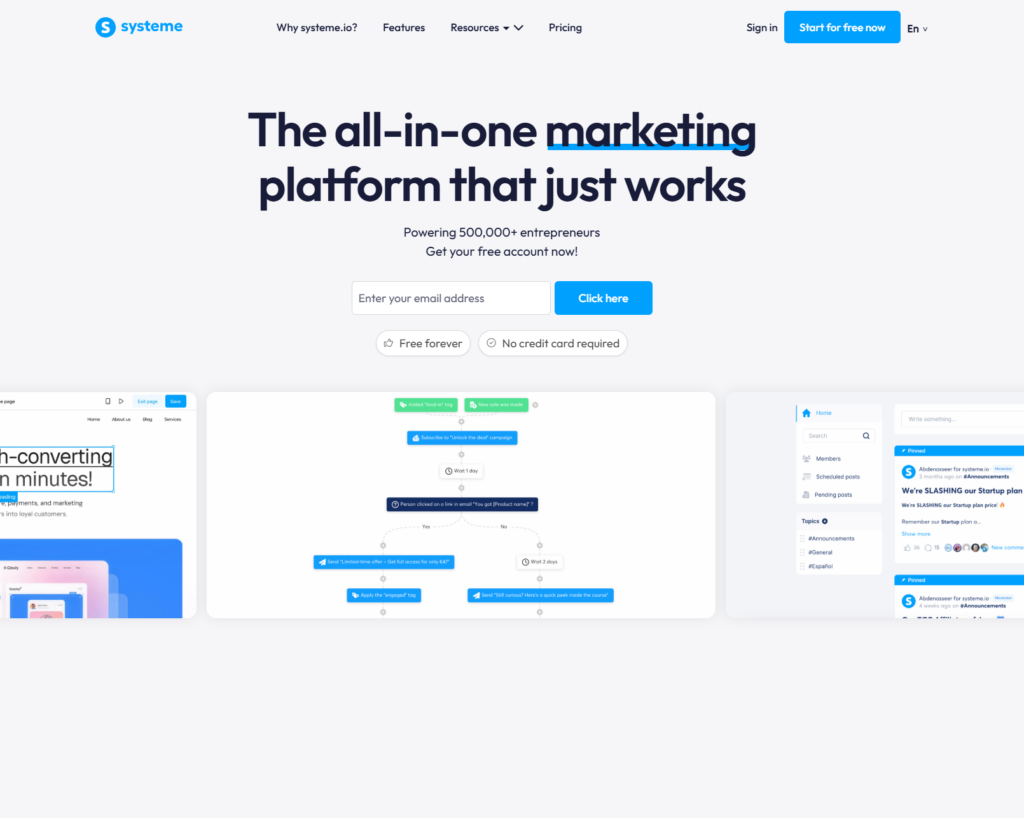
Systeme.io is an integrated marketing suite designed for deploying and scaling digital products. Within a single Dashboard, it provides a website and landing page builder, sales funnel creation, email marketing automation, and tools for payment processing and digital content delivery (courses or restricted access areas). The platform is engineered for rapid deployment; its drag-and-drop editor and pre-configured scenarios allow users to assemble a landing page and link it to email triggers without requiring external integrations.
Key Strength: The primary advantage of Systeme.io is its cohesive lifecycle integration: “Page → Lead/Payment → Automated Email Sequence → Product Delivery.” This is highly efficient for experts, online schools, small SaaS startups, and micro-businesses where speed-to-market and conversion rates take precedence over complex, bespoke frontend layouts. Furthermore, the platform offers a competitive free Pricing Plan that includes core features with specific caps on the number of funnels, automation rules, custom domains, and contacts.
Limitations: Systeme.io shares common constraints with other “all-in-one” marketing suites: it lacks the design granularity and deep customization options for multi-page sites found in specialized builders or CMS platforms. Consequently, it is rarely the first choice for complex corporate portals, non-standard user interfaces, or large-scale content-heavy projects.
Target Audience: Subject matter experts, online academies, and micro-SaaS projects.
3. GetResponse: A Lead Generation Powerhouse
While GetResponse is fundamentally an email marketing and automated funnel platform, it includes a functional landing page builder and a basic website constructor. It is primarily utilized for lead generation workflows: deploying a landing page, integrating data capture forms, and configuring automated email sequences, segmentation, and triggers. The visual editor utilizes block-based templates and supports responsive design, enabling rapid deployment without a dedicated frontend developer.
Key Strength: The platform’s core advantage lies in the seamless integration of “Page + Lead Capture + Marketing.” Built-in subscription forms, A/B testing, analytics, CRM components, and automation logic often take priority over granular design customization. This makes it a robust choice for online schools, SaaS, consulting services, and small businesses requiring the rapid launch of marketing campaigns and automated funnels.
Limitations: As a full-scale multi-page website builder, GetResponse generally lacks the design flexibility, structural depth, and content scalability found in specialized platforms. It functions effectively as an integrated marketing suite for landing pages and simple sites, but it is not the optimal choice for complex corporate portals or heavy content-driven projects.
uKit Website Builder: A Solution for Small Business
uKit is a website builder designed for small businesses and freelancers, focused on the rapid deployment of landing pages and small-scale corporate sites without requiring development skills. Operating on a “block-assembly-to-publish” workflow, the editor provides pre-defined sections, industry-specific templates, and fundamental design settings (typography, color palettes, and grid layouts), ensuring minimal time-to-market.
The platform includes integrated hosting and SSL. It natively supports responsive design for mobile devices and standard SEO configurations: meta tags, SEF (Search Engine Friendly) URLs, redirects, robots.txt management, and sitemap generation. Marketing capabilities include lead capture forms, messenger widgets, analytics/pixel integration, and custom domain mapping.
Key Strength: Simplicity and predictability. The interface is highly beginner-friendly, ensuring that standard sites maintain a clean, professional aesthetic even without prior design expertise.
Limitations: Limited flexibility for high-complexity deployments. The platform lacks full source code control, advanced scripting, and deep logic customization. For non-standard interfaces, large-scale content projects, or complex e-commerce, more “technical” platforms are preferable.
Infrastructure Note: uKit servers are located in Russia. For global projects targeting English-speaking markets or Tier-1 regions (e.g., USA, EU, Brazil), international platforms like SendPulse or Systeme.io are recommended to ensure optimal latency (TTFB) and regulatory compliance.
Conclusion: Selecting the Optimal Website Builder
To determine the best solution, define your specific site requirements and the functional dependencies your project needs. The most effective approach is hands-on evaluation: all paid platforms provide a trial period, which is sufficient to audit the features and performance of the selected service. There is no universal “ideal” platform; the choice depends entirely on your operational goals:
- Advanced Sales Funnels & Chatbot Automation: SendPulse.
- Online Courses & Global Markets (Tier-1): Systeme.io.
- Focusing on high-performance lead generation and marketing? — GetResponse.